Closing the Gap Left by Missing Teeth
A missing tooth rarely stays a small, isolated problem for long. Neighboring teeth can begin to shift into the empty space, your bite can gradually change, and everyday tasks like chewing can become noticeably more difficult. A dental bridge addresses this by bridging the gap, using one or more replacement teeth that are permanently anchored in place. For patients throughout Prairieville and the surrounding Baton Rouge area, a bridge offers a fixed, secure way to restore both the appearance and function of a complete smile.
Because a bridge is custom-designed to match the shape, size, and shade of your natural teeth, it is built to look and feel like a seamless part of your smile rather than an obvious replacement.
Ask If a Bridge Is Right for YouHow a Dental Bridge Works
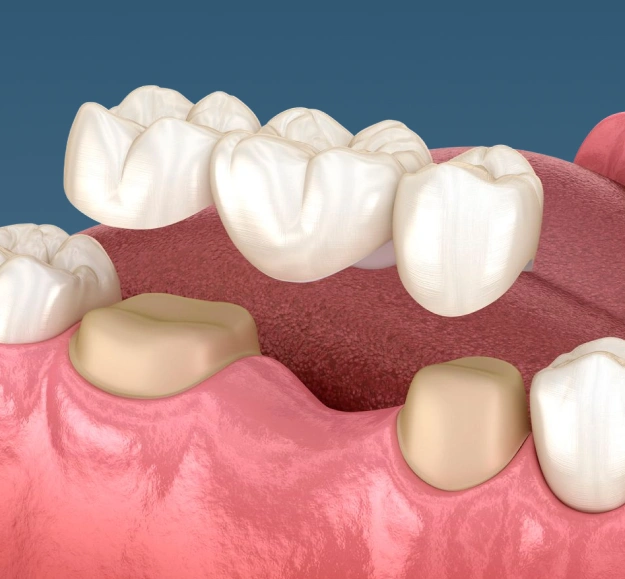
A dental bridge consists of one or more artificial teeth, called pontics, held securely in place by crowns placed on the teeth or implants on either side of the gap. These supporting teeth, known as abutments, are shaped to accept a crown, which then anchors the entire bridge firmly in position. Because the bridge is cemented into place rather than removed daily, it functions much like your natural teeth, allowing you to bite, chew, and speak without the extra steps that come with a removable appliance.
Types of Dental Bridges
The right dental bridge depends on the location of the missing tooth or teeth, the condition of nearby teeth, and overall oral health.
- Traditional Bridge: This option uses dental crowns on the teeth on either side of a gap to hold an artificial tooth, called a pontic, in place. It is commonly used when healthy adjacent teeth are available for support.
- Cantilever Bridge: A cantilever bridge is supported by a crown on one side of the gap. It may be considered when only one neighboring tooth can provide support.
- Implant-Supported Bridge: Rather than relying on natural teeth, this bridge is secured by one or more dental implants. It can be an option for replacing several consecutive missing teeth while preserving nearby natural teeth.
Designing and Placing Your Bridge
Placing a dental bridge typically takes place over a couple of visits, allowing time for your custom bridge to be crafted precisely to fit your bite.
Exam and Treatment Planning
We evaluate the gap left by your missing tooth or teeth, along with the health of any teeth that would support the bridge, to confirm this is the right treatment for your situation.
Preparing the Abutment Teeth
The supporting teeth on either side of the gap are gently reshaped to accept the crowns that will anchor your bridge.
Impressions or Digital Scanning
Detailed impressions or scans of your teeth are captured and used to design a bridge that fits precisely and matches your natural tooth shade.
Temporary Bridge Placement
A temporary bridge is placed to protect your prepared teeth and maintain your appearance while your permanent bridge is being fabricated.
Fitting Your Permanent Bridge
Once ready, your custom bridge is carefully checked for fit, comfort, and bite alignment before being adjusted as needed.
Final Bonding
After confirming everything fits properly, your bridge is permanently cemented into place, completing your restoration.
Signs a Bridge May Be Right for You
A dental bridge may be worth discussing with our team if you are experiencing any of the following:
- One or more missing teeth that have not yet been replaced
- Difficulty chewing certain foods due to a gap in your smile
- Nearby teeth that have started to shift or tilt into an open space
- Changes in your bite that developed after losing a tooth
- A preference for a fixed, non-removable solution over a removable denture
A consultation can help confirm whether a bridge, or another restorative option, is the best fit for your specific case.
Caring for Your Bridge
A dental bridge can provide lasting function with consistent daily care. Brush around the bridge and supporting teeth twice a day, and clean beneath the pontic, the replacement tooth, where a standard toothbrush cannot reach. A floss threader or water flosser can help remove food particles and plaque from this area.
Avoid chewing ice or other hard objects that could damage the bridge or its supporting crowns. Routine cleanings and exams allow the Smart Dental Care team to monitor the bridge and gum health over time. Contact the office if the bridge feels loose, causes discomfort, or no longer fits as it should.
Restore a Complete, Functional Smile
A gap in your smile does not have to be permanent. Schedule a consultation with Smart Dental Care in Prairieville to see if a dental bridge is the right way to restore your bite and your confidence.
Book a VisitFrequently Asked Questions About Dental Bridges
With proper care, dental bridges typically last ten to fifteen years or longer, depending on the material used and how well the surrounding teeth and gums are maintained.
No. A traditional dental bridge is permanently cemented into place, functioning much like your natural teeth rather than being removed for cleaning.
A bridge is fixed in place using crowns or implants, while a partial denture is removable and relies on clasps that attach to your remaining natural teeth.
In a traditional bridge, the teeth on either side of the gap are reshaped to support crowns. Implant-supported bridges can sometimes avoid this by relying on implants instead.
The teeth being prepared are numbed beforehand, so most patients feel little to no discomfort during the procedure. Some mild sensitivity is normal for a short time afterward.
Yes. An implant-supported bridge uses one or more dental implants for support instead of natural teeth, which can be a good option for patients missing several teeth in a row.
A floss threader or water flosser is typically used to clean beneath the pontic, since standard floss cannot easily reach that area on its own.
Many dental insurance plans provide at least partial coverage for bridges, since they are considered a functional, restorative treatment. Our team can help verify your specific benefits.